Your AWS contract auto-renews annually unless you give 90 days written notice via certified mail.
Your SaaS vendor can increase pricing at renewal with just 60 days notice — and if you don't respond, you've accepted the new rate.
Your committed spend doesn't roll over. That $120,000 annual commitment? Any unused portion is forfeited at year-end.
Most vendor contracts contain clauses that will cost you money if you miss them. Auto-renewal traps, pricing escalation rights, committed spend forfeiture — these are standard terms in agreements that most ops teams sign without reading past page two. They only matter on the one day you need to act on them, which is exactly the day you won't remember they exist.
The problem with contract review
Most ops and finance teams at 10–100 person companies don't have in-house legal counsel. When a new vendor contract comes in, the realistic workflow looks something like this: skim the first page for the price, check the term length, sign it, and file the PDF somewhere it will never be opened again.
The critical details — auto-renewal mechanics, notice delivery requirements, pricing escalation rights, termination restrictions — live deep in the document. They're written in legal language designed to be precise, not readable. And they only matter on the one day when you need to act on them, which is exactly the day you won't remember they exist.
This is the gap Renewl was built to close. We already extract the key dates — expiry, renewal, notice period — so you get alerts before anything surprises you. But knowing whena contract renews isn't enough if you don't know what happens when it does.
Introducing Contract Intelligence
After you upload a contract and confirm the extracted dates, Renewl now runs a second AI analysis pass across the full document. It reads every clause and surfaces the ones that create business risk — with specific, actionable recommendations.
This isn't a summary. It's not a chatbot you have to prompt. It's a structured risk assessment that runs automatically and presents findings in three categories:
Clauses that create financial risk or limit your flexibility. These are the ones that cost money when missed. Auto-renewal traps, pricing escalation rights, non-compete restrictions, rollover limitations.
Clauses that protect you or work in your favour. Reciprocal notice periods, included support tiers, price caps. These confirm what's going well so you don't renegotiate terms that already favour you.
Clauses worth knowing but not urgent. Notice delivery requirements, jurisdiction details, confidentiality scope. Context that matters when you eventually need to act.
What it actually finds
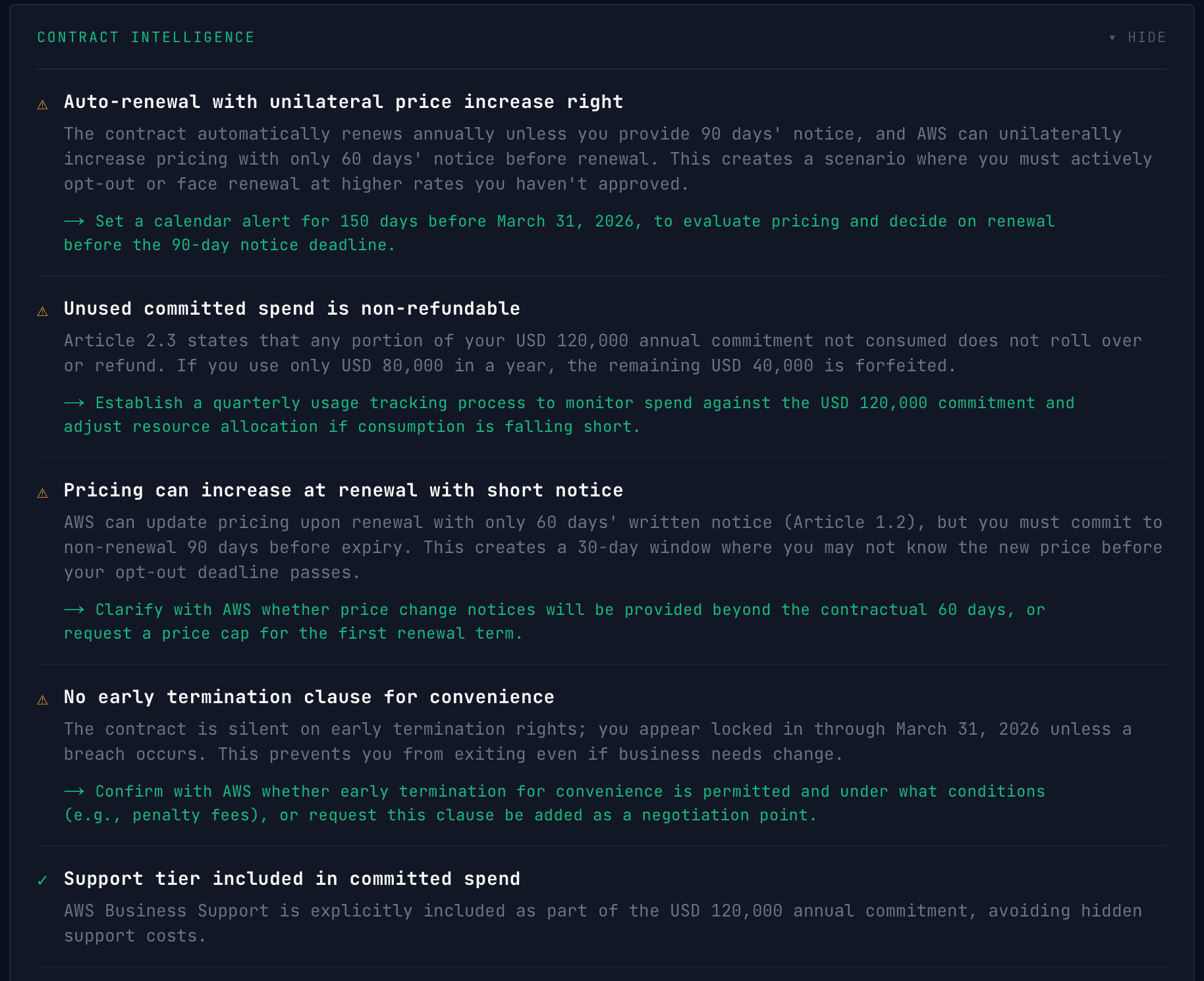
Here's what Contract Intelligence surfaced on a standard AWS Enterprise Agreement:
The contract automatically renews annually unless you provide written notice 90 days before expiration. Missing this deadline by even one day locks you into another year.
→ Set a calendar reminder for 90 days before expiry to decide on renewal status and submit written notice if you want to exit.
AWS can unilaterally raise pricing at renewal with only 60 days notice, and you must accept it or trigger the 90-day non-renewal notice. This creates a compressed decision window.
→ Plan to request pricing terms in writing before the notice window opens to lock rates.
Any unused portion of your annual commitment is forfeited at each year-end with no credit forward. This creates risk of wasted spend if usage fluctuates.
→ Conduct a quarterly utilisation review and plan year-end usage to avoid leaving committed spend on the table.
Non-renewal notices must be sent via certified mail, overnight courier, or email with read receipt. A casual email may not satisfy the requirement, and informal notice could be deemed invalid.
→ When submitting non-renewal notice, use certified mail or email with read receipt to create documented proof of timely delivery.
Every finding comes with a specific action item — not “review this clause” but exactly what to do and when to do it.
Renewl analysis, based on a standard AWS Enterprise Agreement uploaded to the platform. Findings are representative of clause types commonly present in enterprise cloud and SaaS agreements.
How it works under the hood
Contract Intelligence uses the same AI that powers Renewl's date extraction — Claude, by Anthropic — but with a different objective. Instead of looking for dates and values, the second pass analyses the full contract text for:
- Clauses that create financial exposure (auto-renewal, escalation, penalties)
- Asymmetric terms that favour the vendor over the buyer
- Missing protections that should be present (data deletion, termination rights, liability caps)
- Operational requirements that are easy to miss (notice methods, jurisdiction, compliance obligations)
- Positive terms worth preserving in future negotiations
The analysis runs automatically after you confirm a contract's extracted dates. It doesn't block your workflow — results typically appear within 30 seconds on the contract detail page.
Who this is for
Contract Intelligence is built for the same person Renewl is built for: the ops manager or finance lead who manages vendor relationships but doesn't have a legal team reviewing every agreement.
You shouldn't need a lawyer to know that your SaaS vendor can raise prices with 60 days notice. You shouldn't need to re-read a 30-page PDF to find out that your non-renewal notice has to be sent via certified mail. And you definitely shouldn't find out about a use-it-or-lose-it committed spend clause in December when it's too late to do anything about it.
This feature surfaces those risks the moment the contract enters your system — when you still have time to act.
Try it now
Contract Intelligence is available on all Renewl plans, including free. Upload a vendor contract, confirm the extracted dates, and the risk analysis runs automatically.
If you've already got contracts in Renewl, open any confirmed contract and you'll see the Contract Intelligence panel on the detail page.
Frequently asked questions
What is AI contract risk analysis?
AI contract risk analysis is when software reads your vendor agreements and flags clauses that create financial risk — things like auto-renewal traps, pricing escalation rights, and committed spend rules. Renewl's Contract Intelligence does this automatically after you upload a contract, with no manual prompting required.
What hidden risks does Renewl find in vendor contracts?
Renewl surfaces auto-renewal mechanics, pricing escalation clauses, asymmetric terms that favour the vendor, missing protections like termination rights, and operational requirements like notice delivery methods. Each finding includes a specific action item — not just a flag.
Does AI contract analysis replace a lawyer?
No. AI contract analysis is not legal advice. It helps you understand what's in your contract so you know what deadlines to watch and what questions to ask. For significant contract decisions, consult qualified legal counsel.
How does Renewl's Contract Intelligence work?
After you upload a contract and confirm the extracted dates, Renewl runs a second AI analysis pass across the full document using Claude by Anthropic. It categorises findings as Warnings (financial risk), Positives (terms that protect you), or Info (operational details worth knowing). Results appear within 30 seconds.
What types of contracts does AI risk analysis work on?
Renewl's Contract Intelligence works on SaaS subscriptions, cloud infrastructure deals, service agreements, and enterprise software contracts. It's built for the standard commercial contracts that small ops and finance teams sign regularly.
Stop losing money on renewals you forgot about.
Upload a vendor contract and Contract Intelligence surfaces the hidden risks automatically — auto-renewal traps, pricing escalation rights, notice delivery requirements, and more.
Contract Intelligence is powered by Claude and is provided for informational purposes only. It is not legal advice. Always consult qualified legal counsel for contract decisions.